Working with private landowners in the northern Western Ghats to conserve biodiversity-rich forests in India
Jayant Sarnaik, Archana Godbole, Gunwant Mahajan
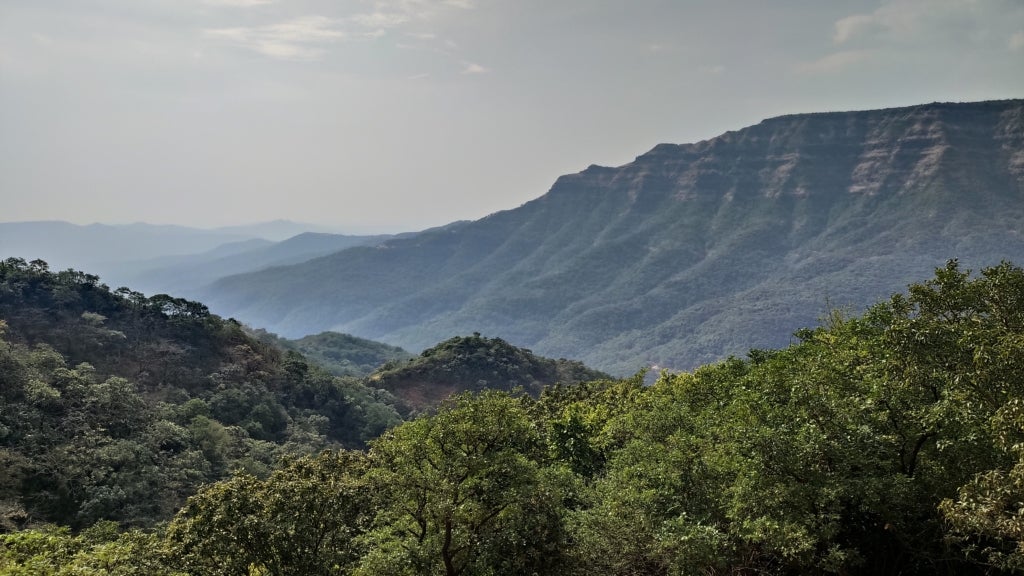
India, one of the world’s 17 megadiverse countries, is home to four global biodiversity hotspots. One of these, the Western Ghats, is among the most heavily populated hotspots in the world, providing critical land and water resources to more than 400 million people across six Indian states. Running approximately 1,000 miles from north to south along the western edge of the Deccan plateau, the mountain range hosts 30% of the country’s biodiversity despite representing just 6% of its land area.
In 2021, India joined the High Ambition Coalition for Nature and People, a group of more than 115 countries that played a key role in adopting Target 3 of the Kunming-Montreal Global Biodiversity Framework, which aims to protect 30% of the planet’s land and ocean by 2030. Currently, protected areas in India cover about 7.5% of the country’s land area. There is growing recognition that conserving India’s biodiversity effectively, equitably, and durably will require going beyond protected areas to achieve landscape-scale outcomes in partnership with private landowners and communities.
In this context, the Applied Environmental Research Foundation (AERF) has led a remarkable initiative over the past two decades to work with communities in the Western Ghats to conserve threatened biodiversity in unprotected forest landscapes.
The origin of India’s first incentive-based private forest conservation initiative
In 2005, AERF’s field research team conducted a conservation assessment of rare and endemic tree species in the northern Western Ghats. The study revealed that, in addition to sacred groves—traditionally protected old-growth forest fragments—many of these species were located on privately owned community lands. These trees were commonly used for timber and fuelwood, prompting AERF to explore approaches that would provide incentives for community members to protect forests.
Working with a geospatial mapping expert, AERF analyzed forest cover and degradation across the region, alongside community surveys and land record reviews in pilot villages. The findings showed that in Ratnagiri district, where most of AERF’s work was focused, 99.5% of land was owned by local communities, with approximately 40% under forest cover. These 330,000 hectares (about 815,000 acres) of private forests represented a significant opportunity for conservation, as well as for raising awareness among communities, government institutions, and research organizations about the importance of landscape-scale approaches.
AERF conducted a first-of-its-kind of study to map important plant areas (IPAs) using a methodology developed by Plantlife International in 2006. This work identified areas of high biodiversity value and helped prioritize sites for private forest conservation. The assessment highlighted 26 high-priority sites across the Ratnagiri and Sindhudurg districts. At the same time, AERF carried out field research on the economic drivers of deforestation to better understand the factors contributing to biodiversity loss.
Together, these studies informed AERF’s development of an incentive-based private forest conservation initiative in the northern Western Ghats, supported by a Rufford Small Grant in 2008. Known as MyForest, this remains India’s first and only initiative of its kind.
In the 2008 pilot phase, AERF set a modest goal of protecting about 40 hectares (100 acres) of private forest. IPA findings were used to select conservation sites, and AERF worked closely with local communities to design an incentive mechanism—a process that took nearly a year to build trust and shared understanding. In 2008 and 2009, two communities signed the first conservation agreements, covering approximately 10 hectares (25 acres), marking a major milestone for the initiative.
Evolution and growth
Despite initial challenges in securing public and private support, AERF’s participation at a 2009 conference hosted by Conservation International helped raise its visibility among key decision-makers. The organization was subsequently invited to join the Conservation Stewards Program (CSP), a global initiative supporting land conservation in biodiversity hotspots. A network meeting organized by CSP in Guatemala further increased AERF’s recognition within the global conservation community, although it remained relatively little known within India at the time.
From 2009 onward, AERF partnered with the Critical Ecosystem Partnership Fund (CEPF) to implement two major projects in the northern Western Ghats focused on community-based biodiversity conservation. These initiatives enabled engagement with a wide range of stakeholders, including the private sector, to design and scale effective conservation strategies. AERF established partnerships with companies such as Daikin Industries and Credit Suisse to highlight the ecological and economic importance of private forests.
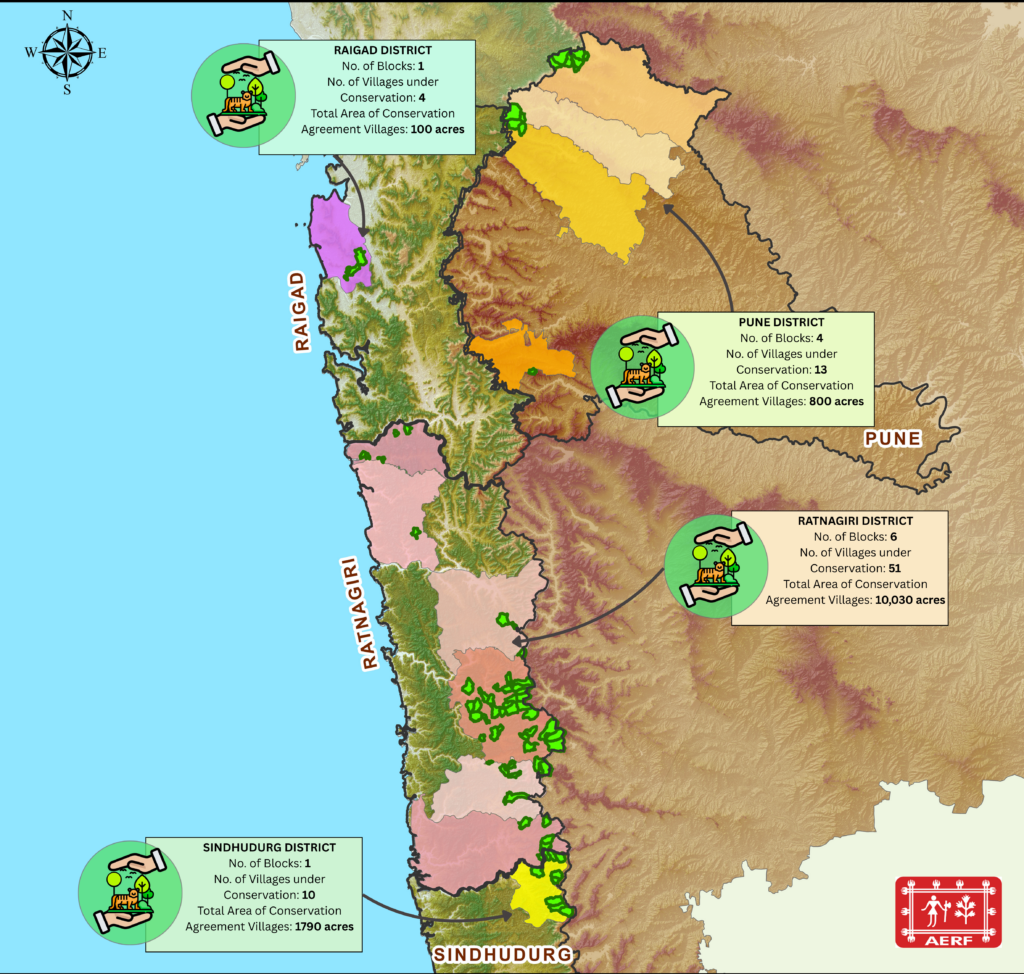
With sustained support from these partners, along with collaborations with organizations such as Rainforest Trust, World Land Trust, and Conservation International, AERF has expanded and sustained the MyForest initiative across 120 villages in four districts of the northern Western Ghats. Today, the program protects biodiversity-rich private forests spanning more than 6,000 hectares (about 15,000 acres), safeguarding endangered species and critical ecosystems in partnership with local communities.